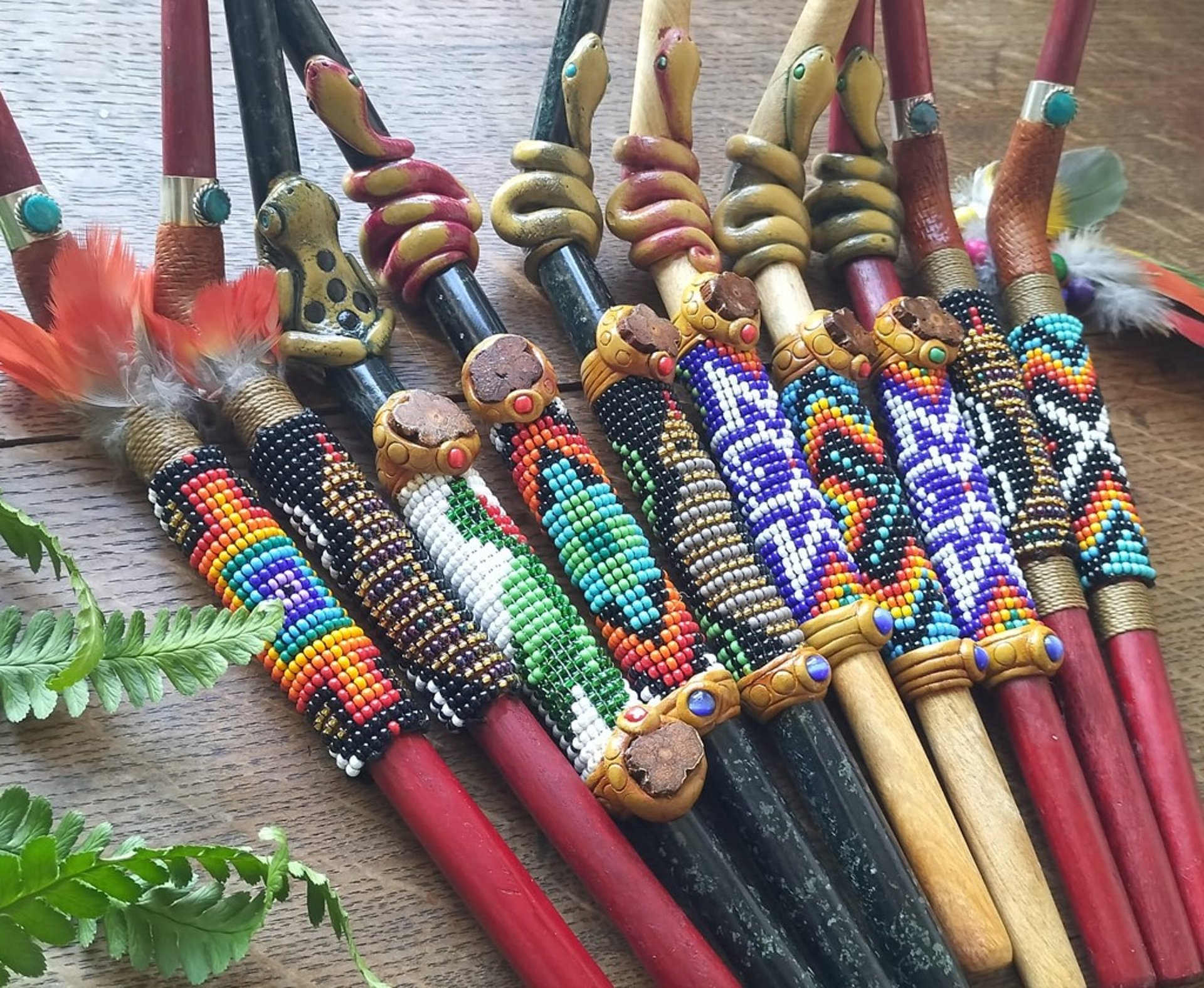
Choosing Your Hapé Applicator Pipe
The Kuripe and the Tepi are the two traditional instruments used to administer Hapé in Amazonian ceremonial tradition. Understanding the difference between them — and knowing which one is right for your practice — is an important step in developing a respectful and effective relationship with this sacred medicine.
A Kuripe is a self-application pipe. It is V-shaped, with one end placed at the nostril and the other at the lips. You blow the Hapé into your own nose using a single controlled breath. The Kuripe gives the practitioner complete control over timing, dosage, and the pace of the ceremony. It is ideal for solo practice, daily use, and for those who prefer to receive the medicine in a private, self-directed way.
A Tepi, by contrast, is a longer pipe used for partner application. One person prepares the Hapé in the pipe while another receives it. The facilitator blows the medicine into the receiver's nostril using a steady, intentional breath. The Tepi is traditionally used in group ceremonies where an experienced facilitator administers the medicine. The experience of receiving through a Tepi is often described as more potent and surrendering, because the receiver must trust the facilitator completely.
At Pillars of Light, our collection of Kuripes and Tepis spans a wide range of materials and traditions. We carry hand-carved bamboo pipes from the Amazon, bone pipes from the Shipibo and Huni Kuin traditions, crystal-tipped pipes for those who work with mineral energy, and ornately beaded pipes in the Shipibo style that are as beautiful as they are functional.
When choosing your pipe, consider your primary use case. For daily personal practice, a simple, durable bamboo Kuripe is ideal. For ceremony facilitation or group work, invest in a quality Tepi that you will care for as a sacred tool. For gifting or altar display, our hand-carved and beaded pipes are exceptional in their artistry and intention.
Each pipe in our collection is cleansed and prepared before shipping. We recommend further cleansing with sacred smoke — Palo Santo, copal, or Mapacho — upon receipt. Store your pipe in a clean, dry place with intention. Treat it as the sacred ceremonial tool it is, and it will serve you faithfully for years.
About Our Kuripe and Tepi Collection
At Pillars of Light, every Kuripe and Tepi in our collection is hand-selected from Indigenous artisans across the Amazon — primarily from communities in Brazil, including the Shipibo, Huni Kuin, and Fulni-ô peoples. These are not mass-produced items. Each pipe is crafted by hand with intention, prayer, and care.
What is a Kuripe? A Kuripe is a V-shaped self-applicator used to administer hapé to yourself. One end rests gently in your nostril; the other goes to your lips. You blow the medicine into your own nose. The Kuripe is an essential tool for solo hapé practice.
What is a Tepi? A Tepi is a longer, straight blowpipe used when serving hapé to another person. It is a tool of ceremony and service — the pipe that connects the facilitator to the recipient.
Our in-store collection in Old Town Spring, TX is one of the largest selections of handcrafted Kuripes and Tepis in the United States. Visit us at 318 Main Street, Suite D, Spring, TX 77373 to hold and choose your pipe in person.
Materials in our collection: Alpaca bone · Chonta wood · Bamboo · Palo Santo · Ayahuasca vine (Banisteriopsis caapi) · Crystal and gemstone settings (quartz, tigers eye, chrysocolla) · Rosewood · Shipibo beadwork
Choosing your first pipe: Trust what calls to you. If you are new to hapé, a Kuripe is the right starting point — it puts you in direct relationship with the medicine and lets you find your own pace. If you are facilitating ceremonies, a Tepi becomes your tool of service.
Shop Kuripes — Self-Applicator Pipes for Hape
A kuripe is the V-shaped pipe you use to serve hape to yourself: one end at the nostril, the other at your lips. If you are new to hape, a kuripe is the usual place to start. Not sure which pipe fits your practice? Read our Kuripe vs Tepi guide.
Double Kuripes
More Kuripes
Shop Tepis — Pipes for Serving Hape to Another Person
A tepi is the longer pipe one person uses to serve hape to another. Each one below is handcrafted, and many feature Shipibo-style beadwork, alpaca bone, rosewood, or palo santo.
Shipibo Red and White Beaded Bone long Tepi with Clear Quartz & Tiger’s Eye
Rosewood & Palo Santo Tepi — Frog, Serpent fox & Flower Design
Long Alpaca Bone Tepi — Shipibo Beadwork, Huayruro Seed, Peruvian Stone & Ayahuasca Piece
Alpaca Bone Tepi with Kambo Frog, Turtle, and Shipibo Beadwork
U-Shaped Tepi — Handwoven Shipibo Design with Dark Wood & Tiger’s Eye
Very Long U-Shaped Alpaca Bone Tepi — Shipibo Beadwork, Clear Quartz & Turquoise Accents
Shipibo-Beaded Bone Tepi with Andean Cross, Fox, Snake & Sea Turtle
U-Shaped Bone, Leather & Rosewood Tepi — Blue Emerald & Tiger’s Eye
Wave-Shaped Tepi — Handwoven with Anaconda Skin, Blue/Green/Pink Accents, Gems & Ayahuasca Wood
Wave-Shaped Alpaca Bone Tepi — Handwoven Blue & Black Shipibo Design with Anaconda Skin
Long Rosewood Tepi — Shipibo Beadwork, Ayahuasca & Peruvian Stone
Long Single-Nose Rosewood Tepi — Shipibo Beadwork, Ayahuasca & Peruvian Emerald
Palo Santo & Alpaca Bone Crystal Tepi — Hand-Painted with Ayahuasca Wood Design
U-Shaped Rosewood Tepi — Handwoven Shipibo Design with Tiger’s Eye
Prefer to choose in person? Visit Pillars of Light at 318 Main Street, Suite D, Spring, TX 77373, or buy hapé online in our Hapé Apothecary to pair your pipe with a blend.